
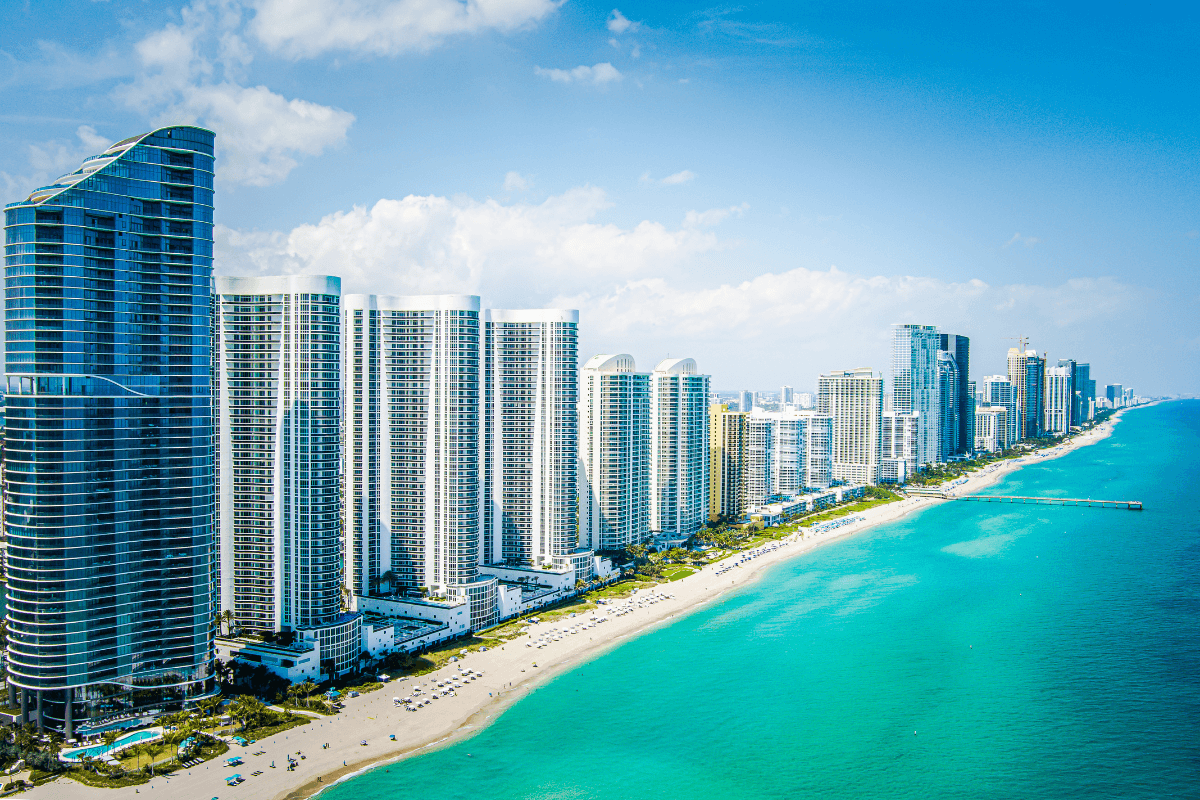
Miami is 2 hours and 49 minutes from Dallas by air. The geography is misleading — both cities are in the same country, the same time zone, and connected by 84 nonstop flights a week, but Miami runs on a different operating system. It was incorporated in 1896, transformed by the 1959 Cuban Revolution that brought roughly 250,000 refugees in the first wave, and again by Caribbean and South American migrations in the decades since. Spanish is the dominant language in many neighborhoods. Cuban coffee is the social currency. The city is the unofficial capital of Latin America, and you feel that within an hour of landing.
This guide covers what Dallas travelers need to know before going: flight logistics from DFW, neighborhood breakdowns from South Beach to Little Havana, restaurant recommendations with the names and history behind them, weather realities, transit, and budget. No filler, no tourism-board language — just the information that helps you plan a trip worth taking.
Getting to Miami from Dallas
Nonstop Flights from DFW
American Airlines, Spirit Airlines, and Frontier Airlines all fly nonstop from DFW to Miami International Airport (MIA). American operates the dominant share — roughly 84 weekly nonstops, averaging 4 to 5 flights per day on narrowbody jets. Spirit and Frontier add ultra-low-cost options at lower base fares with paid bags and seat selection. The first daily departure is typically around 5:00 AM and the last is around 9:30 PM, giving you arrival times that work for either a late dinner or a full work day at home.
Flight time is approximately 2 hours and 49 minutes outbound on the eastbound trip, and slightly longer on the return because of prevailing winds. Roundtrip fares typically range from $175 to $400 depending on season, with frequent drops below $200 and occasional mistake fares under $150. Spring break (March) and the December holidays push prices up. May and September are the cheapest months because they're shoulder seasons that fall outside both winter migration and summer family travel.
Southwest does not fly nonstop from Love Field to Miami, though Southwest does serve Fort Lauderdale (FLL), 30 miles north of Miami. If a Love Field nonstop matters to you, FLL plus a Brightline train ride into downtown Miami is a reasonable workaround.
From the Airport to the City
MIA is 8 miles from downtown Miami and 13 miles from South Beach. In normal traffic, the drive to downtown takes 15 to 20 minutes. South Beach takes 25 to 35 minutes and is famously variable depending on the MacArthur Causeway. Rideshare from MIA averages $25 to $40 to downtown or Brickell and $35 to $55 to South Beach.
The cheapest option is the Metrorail Orange Line, which connects directly to MIA via a free people-mover called the MIA Mover. Tap in for $2.25 with an EASY Card or contactless payment, and you're at Government Center in downtown Miami within 20 minutes. From Government Center you can transfer to the free Metromover (a downtown people-mover that loops Brickell, downtown, and the Arts District at no charge) or pick up a bus to other parts of the city.
For Fort Lauderdale arrivals, Brightline runs high-speed rail from FLL to Miami Central Station downtown. The trip is about 30 minutes. From Miami Central, you connect to Metrorail, Metromover, Metrobus, or the free Miami Trolley. Brightline also offers an airport connector shuttle to MIA for $12 with a same-day Brightline ticket, operating 8 AM to 7 PM.
DFW to Miami at a Glance
- Nonstop: American Airlines (84 weekly), Spirit, Frontier
- Flight time: ~2 hr 49 min outbound, slightly longer on return
- Time difference: Miami is one hour ahead of Dallas (Eastern vs Central)
- Airport to downtown: 8 miles, ~15-20 min by car, $2.25 by Metrorail
- Airport to South Beach: 13 miles, 25-35 min by car
- Typical roundtrip fare: $175-$400 (deals drop below $150 a few times a year)
- Best for: Long weekends through full-week trips
Understanding the Neighborhoods
Miami is sprawling and decentralized. There is no single "downtown experience" the way there is in New Orleans or Charleston — different neighborhoods serve very different purposes, and the geography matters. The city itself is on the mainland, while Miami Beach (including South Beach) is on a barrier island connected by causeways. A quick orientation helps you decide where to stay and where to spend your days.
South Beach
South Beach is the southern end of Miami Beach, the barrier island east of the mainland. It is what most people picture when they think of Miami: ocean, palm trees, neon at night, and the largest concentration of Art Deco architecture in the world. The Miami Beach Architectural District, designated in 1979, contains roughly 800 preserved buildings from the 1920s to 1940s. They are short, geometric, pastel, and almost all walkable along Ocean Drive, Collins Avenue, and Washington Avenue.
The Art Deco era began here in 1925 after a hurricane destroyed much of the previous coastal development. Architects rebuilt with what was then a futuristic style — porthole windows, racing stripes, neon signs, terrazzo floors. The hotels along Ocean Drive between 5th and 15th Streets are the densest concentration. The Miami Design Preservation League runs walking tours that depart from the Art Deco Welcome Center at 1001 Ocean Drive. Self-guided tours are also available with audio guides for $20.
Lincoln Road, three blocks north of the Welcome Center, is a pedestrian mall designed by Morris Lapidus in 1960. It runs from Washington Avenue to Alton Road. Most of South Beach is walkable end-to-end in 20 minutes. The southern tip — South of Fifth, often called "SoFi" — is calmer and more residential, and home to several of the city's better restaurants.
Wynwood
Wynwood, on the mainland north of downtown, was a working-class garment-manufacturing district through most of the 20th century. By the early 2000s the warehouses were largely abandoned and the neighborhood was known as Little San Juan because of its Puerto Rican community. Real estate developer Tony Goldman started buying properties in 2009 and commissioned street artists to paint the warehouse walls. The result was the Wynwood Walls, an outdoor mural park that opened that year and now draws artists from around the world.
The walls function as both an art installation and a magnet for the rest of the neighborhood. Galleries, breweries, and restaurants moved in. Wynwood is now Miami's primary arts district, with first-Saturday gallery walks, a thriving outdoor mural scene, and a restaurant culture that ranges from taco trucks to Michelin-starred fine dining. Wynwood Brewing Company at 565 NW 24th Street was Miami's first craft brewery when it opened in 2013.
Little Havana
Little Havana is the cultural center of Miami's Cuban exile community. After the 1959 Cuban Revolution, roughly 250,000 Cubans arrived in Miami in the first wave, settling along SW 8th Street west of downtown. SW 8th Street is known locally as Calle Ocho ("Street Eight" in Spanish), and the stretch between SW 12th Avenue and SW 27th Avenue is the dense core of the neighborhood.
Versailles Restaurant at 3555 SW 8th Street has been the unofficial gathering place for Miami's Cuban community since 1971. Cuban presidential candidates campaign there. Locals call it "the world's most famous Cuban restaurant." The dining room is bright, mirrored, and busy at all hours; the walk-up coffee window on the side serves cafecito (a small, sweet Cuban espresso) for under $2. Across the street, La Carreta serves the same kind of menu in a similar atmosphere.
Maximo Gomez Park, more commonly called Domino Park, sits at SW 15th Avenue. Older Cuban men gather there daily to play dominoes and chess under the shade trees. It is open to the public and free. The neighborhood also hosts the Calle Ocho Music Festival every March — the largest Latin music street festival in the United States, drawing more than a million people in past years.
Brickell
Brickell is Miami's financial district, just south of downtown across the Miami River. It is dense with high-rise condos, banks, and what some call "the Manhattan of the South." Walking the Brickell Avenue corridor, you pass the headquarters of dozens of Latin American banking divisions — the city's role as the business gateway between North and South America in physical form.
For visitors, Brickell is a good base if you want walkable restaurants and bars and don't need to be on the beach. The Pérez Art Museum Miami (PAMM) sits on Biscayne Bay just north of Brickell at 1103 Biscayne Boulevard, with a permanent collection focused on 20th and 21st century international art and rotating exhibitions. Admission is $16 for adults. The Phillip and Patricia Frost Museum of Science, next door, includes an aquarium and a planetarium. Combined museum tickets and the free Metromover loop make this whole zone easy to cover in a half day.
Coral Gables
Coral Gables was founded in 1925 as a planned community by developer George Merrick. Merrick wanted to build what he called a "City Beautiful" with Mediterranean Revival architecture — stucco walls, red barrel-tile roofs, archways, fountains, plazas. He hired architects to design entire entry gates and ornamental landscaping. The city remains one of the most visually consistent in the country because Merrick's design code is still enforced.
The Biltmore Hotel, built in 1926 and a National Historic Landmark, is the centerpiece. Its 315-foot tower was inspired by the Giralda bell tower in Seville, Spain. The hotel hosted Al Capone, the Duke and Duchess of Windsor, Bing Crosby, and Judy Garland in its early decades. The Biltmore golf course is open to the public and the dining room is a destination on its own.
The Venetian Pool, a city-owned public swimming pool carved out of a coral rock quarry in 1923, is in Coral Gables and listed on the National Register of Historic Places. Admission is around $20 for adults. Miracle Mile, the four-block shopping and dining strip on Coral Way, anchors the walkable downtown.
Coconut Grove and the Design District
Coconut Grove is the oldest continuously inhabited neighborhood in Miami-Dade County. Bahamian settlers arrived in the 1870s, drawn by jobs at early hotels and the schooner trade. By the 1960s the Grove had become a counterculture hub with folk clubs, head shops, and an annual arts festival that still runs each February. Today it is a quieter waterfront village with sailing on Biscayne Bay, shaded streets, and a mix of older bungalows and newer condos.
The Miami Design District, north of downtown between NE 38th and NE 42nd Streets, is a more recent development. Real estate developer Craig Robins acquired most of the neighborhood starting in the late 1990s and rebranded it as a luxury retail and design destination. It is dense with high-end fashion stores, contemporary art installations, and acclaimed restaurants. The architecture is intentional — designed by figures like Sou Fujimoto and Aranda\Lasch — and the area is best walked rather than driven. The Institute of Contemporary Art Miami at 61 NE 41st Street is free.
What to Eat and Drink
Miami's food culture is the product of immigration. Cuban, Haitian, Colombian, Venezuelan, Argentine, Peruvian, and Sicilian traditions all live in the city, and they have started to merge into something specifically Miami. The 2025 Michelin Guide awarded the city 16 Michelin stars, the most of any Florida metro area, including a two-star restaurant. The result is a food scene that runs from $2 cafecito at a walk-up window to $400 tasting menus, all within a short Uber ride.
Cuban Coffee and Cuban Sandwiches
Cafecito is the foundation of Miami's Cuban food culture. It is a small espresso, sweetened with sugar at the moment of brewing so the sugar dissolves into a foam called espuma. A standard cafecito is served in a thimble-sized cup. Colada is the same thing in a larger cup with a stack of small plastic shot cups for sharing — the office coffee delivery format. Versailles, La Carreta, and dozens of walk-up windows along Calle Ocho serve cafecito for $1.50 to $3.
The Cuban sandwich is the city's signature lunch. Roast pork, ham, Swiss cheese, mustard, and dill garnish on Cuban bread, pressed flat. The pressed loaf is the difference — a Cuban sandwich is not a po'boy or a sub. The bread crust crackles. The version in Miami uses no salami, distinguishing it from the Tampa version, which adds it. Sanguich de Miami in Little Havana and Enriqueta's Sandwich Shop in Wynwood are two of the most-cited spots.
Restaurants Worth Planning Around
Joe's Stone Crab (11 Washington Avenue, South of Fifth) opened in 1913 and is the city's oldest restaurant. The menu is built around stone crab claws, which are in season from October 15 through May 1 (they don't serve them otherwise). The claws are sustainably harvested — the crabs regrow them after the legal harvest of one claw per crab. Joe's is famously busy: the wait can be two to three hours during stone crab season, no reservations for the main dining room, though you can call ahead to reserve at the bar or order takeout from Joe's Take Away next door.
L'Atelier de Joël Robuchon Miami (Design District) holds two Michelin stars in the 2025 Michelin Guide — the only two-star restaurant in Florida. It is the late chef Robuchon's signature counter-style French dining concept, with an open kitchen surrounded by a U-shaped bar.
Boia De (Buena Vista) is a Michelin-starred Italian restaurant that has also been a James Beard nominee. Chefs Luciana Giangrandi and Alex Meyer run a tiny dining room. The signature dishes include ricotta gnocchi with brown butter and crispy pig ears with Calabrian chili. It is one of the hardest reservations in the city.
Mandolin Aegean Bistro (4312 NE 2nd Avenue, Buena Vista) is housed in a 1940s converted bungalow with an outdoor patio. Owners Ahmet Erkaya and Anastasia Koutsioukis serve Greek and Turkish food from the Aegean coast — grilled octopus, lamb meatballs, mezze plates. The setting is part of the appeal: you eat under string lights in what feels like a Mediterranean garden.
Versailles (3555 SW 8th Street, Little Havana) opened in 1971 and remains the cultural and political center of Miami's Cuban community. The menu covers traditional Cuban dishes — ropa vieja (shredded beef in tomato), lechon asado (roast pork), arroz con pollo, and fried plantains. The walk-up window on the side serves cafecito and pastelitos (Cuban pastries) all day. Versailles is open until at least midnight every night.
Stubborn Seed (Miami Beach), Cote Miami (Design District, Korean steakhouse), Ariete (Coconut Grove), and The Surf Club Restaurant (Surfside, Thomas Keller) all hold one Michelin star in the 2025 guide. Itamae AO (Design District) earned its first star in the same guide — a Peruvian-Japanese (Nikkei) restaurant from chefs Nando and Valerie Chang.
Casual Cuban and Latin
Miami's value is not at the high end. The everyday food culture — cafecitos, Cuban sandwiches, Colombian arepas, Venezuelan empanadas, Peruvian ceviche — is where the city actually eats, and it is where you should spend most of your meals. Doce Provisions in Little Havana, Versailles' walk-up window, El Mago de las Fritas on Calle Ocho (Cuban-style hamburgers with shoestring potatoes called fritas, since 1984), Sergio's (Cuban diner chain), and any of the small arepa places in Doral all hit at the under-$15 price point.
Music, Art, and Cultural Traditions
The Cuban Influence on Music
Miami's musical identity was shaped by the same wave of Cuban migration that built Little Havana. Cuban musicians arriving in the 1960s carried son cubano, mambo, cha-cha, and rumba traditions that intersected with American R&B, jazz, and disco to produce what became known as the Miami Sound. Gloria Estefan and the Miami Sound Machine emerged from this scene in the late 1970s, mixing Cuban rhythms with English-language pop. The 1985 hit "Conga" was the first single to chart on the Billboard Pop, Latin, R&B, and Dance charts simultaneously.
The city is also a global capital for reggaeton and Latin trap. Daddy Yankee, Pitbull, J Balvin, Bad Bunny, and many of the genre's most-streamed artists have spent significant time recording in Miami. Many of the major Latin labels keep their U.S. operations here.
Art Basel and the Art Calendar
Art Basel Miami Beach is the largest contemporary art fair in the United States. It runs the first weekend of December at the Miami Beach Convention Center. The 2026 dates are December 5 to 7, 2026 with VIP previews on December 3 and 4. More than 250 international galleries exhibit, and the entire city's hotel rates roughly double during fair week. The fair has spawned an entire surrounding ecosystem of satellite fairs (Untitled, Design Miami, NADA, Pulse, Scope), gallery openings, and museum exhibitions throughout Wynwood, the Design District, and South Beach.
Outside of Art Basel week, the city's art infrastructure is genuinely deep year-round: the Pérez Art Museum Miami, the Institute of Contemporary Art Miami, The Bass in Miami Beach, the Frost Art Museum at FIU, and the Wynwood Walls all operate on regular schedules. Wynwood holds Second Saturday Art Walk on the second Saturday of every month with galleries open late and free shuttle service through the district.
Latin Festivals and Calle Ocho
The Calle Ocho Music Festival, held each March on SW 8th Street, is the largest Latin street festival in the United States. The 2026 edition is on March 15, 2026, running 11 AM to 7 PM. It is a single-day event that takes over more than 20 blocks of Little Havana with multiple stages of live Latin music, food vendors, and street performers. Past years have drawn crowds estimated above one million.
When to Go
Weather by Season
Miami has a tropical climate with two real seasons: a warm, dry winter and a hot, wet summer. Annual rainfall averages around 62 inches, more than double Dallas. Most of that rain falls between mid-May and early October, in short heavy bursts that arrive in the afternoon and clear within an hour.
December through April: Highs 75 to 82°F, lows 60 to 68°F. Low humidity, minimal rain, comfortable for any outdoor activity. This is the peak tourist season and hotel rates reflect it. Snowbirds from the Northeast arrive in November and stay through April.
May: Highs around 85°F, lows around 73°F. The sweet spot for value travelers. Rates drop because school is still in session, the F1 Grand Prix is in town the first weekend, and the rainy season is just starting but storms are still brief.
June through September: Highs 88 to 91°F, lows 76 to 79°F. Hot, humid, and wet — daily afternoon thunderstorms, high heat indices, and active hurricane risk. Hotels run their lowest rates of the year. If you can handle the humidity and your travel insurance covers weather disruptions, summer Miami is half the price of winter Miami.
October through November: Highs 82 to 86°F, lows 70 to 75°F. The shoulder back into peak season. Hurricane risk is still elevated through November 30 but humidity drops late in October.
Hurricane season runs June 1 through November 30, with peak activity from mid-August through late September. Buy travel insurance if you're booking summer or early fall trips, and check the National Hurricane Center at nhc.noaa.gov before flying.
Major Festivals and Events in 2026
- Miami International Boat Show: February 11 to 15, 2026
- South Beach Wine & Food Festival: February 19 to 22, 2026 — celebrity chefs, wine tastings, beach parties at multiple venues
- Calle Ocho Music Festival: March 15, 2026 — largest Latin street festival in the U.S., Little Havana
- Ultra Music Festival: March 27 to 29, 2026 at Bayfront Park — one of the world's largest electronic dance music festivals
- Miami Beach Pride: April 11 to 12, 2026 — festival and parade along Ocean Drive
- Formula 1 Crypto.com Miami Grand Prix: May 1 to 3, 2026 at Hard Rock Stadium in Miami Gardens — hotel rates surge city-wide
- Art Basel Miami Beach: December 5 to 7, 2026 with VIP previews December 3 to 4 — the year's biggest event for the city
Practical Information
Budget
Miami runs more expensive than New Orleans or Charleston but cheaper than New York. A budget traveler in a hostel or shared rental, eating cafecitos and Cuban sandwiches, and using public transit can get by on roughly $140 per day. Mid-range — chain hotel or modest South Beach Art Deco hotel, sit-down restaurants, an Uber here and there, a couple of paid attractions — runs $250 to $375 per day. Luxury, especially in South Beach or the Design District during high season, climbs above $600 per day quickly.
Meal costs: cafecito $1.50 to $3, Cuban sandwich $10 to $15, sit-down lunch $18 to $35, fine-dining dinner $80 to $250+ per person before drinks. Attraction prices: Pérez Art Museum Miami $16 adults, Frost Museum of Science $32 adults, Wynwood Walls $12 adults, Vizcaya Museum and Gardens $25 adults. Beaches are free — Miami Beach, South Beach, Crandon Park on Key Biscayne — though parking near them is not.
Getting Around
Miami is sprawling and the public transit network is uneven. The Metrorail (heavy rail, $2.25 per ride) connects MIA to downtown, Brickell, Coconut Grove, Coral Gables, and South Miami. The Metromover (free people-mover) loops downtown and Brickell. The Miami Trolley (free) runs neighborhood circulators in Coral Gables, Coconut Grove, Wynwood, and a few other areas. Metrobus covers what the rail doesn't.
The transit gap is the beach. There is no rail or trolley between the mainland and Miami Beach — only buses and rideshare. If you're staying in South Beach and don't plan to leave often, you can get away without a car. If you're staying on the mainland and want to bounce between Wynwood, the Design District, downtown, Brickell, and Coral Gables, public transit covers most of it. Brightline high-speed rail connects Miami Central Station to Fort Lauderdale, West Palm Beach, and Orlando.
Renting a car is useful if you plan to spend significant time outside the urban core — the Everglades (1 hour west), Key Biscayne, the Florida Keys (Key Largo is 1 hour, Key West is 3.5 hours), or driving up to Fort Lauderdale or Palm Beach.
Safety
Miami-Dade reported violent crime down 17% in early 2025 compared to 2024, with homicides down nearly 40% year-over-year, per Miami-Dade Police data through March 2025. Tourist areas — South Beach, Brickell, Wynwood, Coral Gables, the Design District, and Coconut Grove — are heavily patrolled and well lit, with high foot traffic. Serious violent crime in tourist centers is exceptional.
The realistic crime risk for visitors is property crime: car break-ins (especially in beach parking lots and rental car lots), pickpocketing on Lincoln Road and in Wynwood during peak hours, and theft from unattended bags at the beach. Standard urban precautions apply: don't leave anything visible in a parked car, don't leave bags on the beach unattended, use rideshare instead of walking through unfamiliar neighborhoods late at night, and stay on Ocean Drive or Collins Avenue rather than the beach itself after dark.
Local Terms Worth Knowing
- Cafecito (kah-feh-SEE-toh): Cuban espresso, sweetened during brewing. Ordered at a walk-up window for under $3.
- Colada: A larger cafecito intended for sharing, served with a stack of small plastic cups.
- Calle Ocho (KAH-yeh OH-cho): SW 8th Street, the spine of Little Havana. Literally "Eighth Street" in Spanish.
- Frita: A Cuban-style hamburger topped with shoestring potatoes, served on a Cuban roll. Original at El Mago de las Fritas since 1984.
- SoFi: South of Fifth, the southern tip of South Beach below 5th Street.
- SoBe: Locals call South Beach "SoBe." Don't say "Miami Beach" when you mean "South Beach" — they are not interchangeable.
- The 305: Miami's area code, used as shorthand for the city.
How Long to Stay
Long Weekend: 3 to 4 Nights
Three nights in Miami covers either the beach experience or the city experience, but not both at full depth. The short flight from DFW makes a long weekend realistic if you're willing to be selective about neighborhoods. A workable schedule:
- Day 1: Arrive, settle in, walk Ocean Drive, dinner in South of Fifth or at Joe's Stone Crab (in season)
- Day 2: Beach in the morning, Art Deco walking tour with the Miami Design Preservation League, dinner in the Design District
- Day 3: Wynwood Walls and Wynwood gallery walk, lunch at Sanguich de Miami, late afternoon at Pérez Art Museum, dinner at Mandolin or Boia De
- Day 4: Cafecito in Little Havana, walk Calle Ocho, departure
Full Week: 5 to 7 Nights
A full week lets you split between the beach and the mainland and add a day trip. Add Coral Gables for the Biltmore Hotel and the Venetian Pool, Coconut Grove for waterfront sailing, and a half-day at the Vizcaya Museum and Gardens. For a day trip, drive to Everglades National Park (1 hour west, $30 per vehicle entry) for an airboat tour and short walks at Shark Valley or the Anhinga Trail. Alternatively, drive an hour south to Key Largo for snorkeling at John Pennekamp Coral Reef State Park.
With a week you can also be more deliberate about meals — getting a reservation at one of the Michelin-starred restaurants without rearranging your trip, eating at Joe's Stone Crab without joining the worst of the wait line, and leaving room for the Cuban food the city actually runs on.
Get Flight Deal Alerts from Dallas to Miami
We track DFW-MIA fares daily and publish them to our deal pages, refreshed hourly. Premium subscribers get the live deals dashboard with real-time fare drops and unlimited custom trip alerts by city, dates, and savings threshold.
Frequently Asked Questions
Sources: American Airlines route data (aa.com), Miami International Airport (miami-airport.com), Miami-Dade Transit Metrorail and Metromover schedules (miamidade.gov), Brightline (gobrightline.com), Greater Miami Convention & Visitors Bureau (miamiandbeaches.com), 2025 Michelin Guide Florida selections, Pérez Art Museum Miami (pamm.org), Miami Beach Architectural District designation records, Miami Design Preservation League (mdpl.org), National Hurricane Center (nhc.noaa.gov), Miami-Dade Police Department crime statistics, Weather Spark Miami climate data, Calle Ocho Music Festival official information, Formula 1 Miami Grand Prix (formula1.com), Art Basel Miami Beach.
Get Flight Deal Alerts from DFW & DAL
Free subscribers get our twice-weekly deal newsletter and every deal page on the site, refreshed hourly. Premium adds the live deals dashboard updating in real time and unlimited custom trip alerts by city, dates, and savings threshold.

Read Next
Planning a Trip to New Orleans from Dallas: What to Know Before You Go
A practical guide for Dallas travelers considering New Orleans. Nonstop flight details from DFW, neighborhood breakdowns from the French Quarter to Bywater, restaurant history from Commander's Palace to po'boy origins, cocktail culture, Mardi Gras logistics, and honest advice on when to go and how long to stay.
Planning a Trip to Amsterdam from Dallas: What to Know Before You Go
A practical guide for Dallas travelers considering Amsterdam. Nonstop flight details from DFW, seasonal weather breakdown, arrival logistics at Schiphol, day trip options by train, and honest advice on how long to stay and when to go.